A bilingual education and scientific-software ecosystem combining scalable information architecture, responsive WordPress delivery, customised Jumpseller commerce and long-term digital operations.
PlatformsWordPress · Jumpseller · Portuguese & English
EngagementDesign, delivery and ongoing digital management
01 · Project overview
A scalable bilingual platform for advanced training, scientific software and data-driven consulting.
Gades Solutions is a Portuguese training and technology company serving professionals, researchers and organisations through certified education, scientific software and specialist consulting.
The digital ecosystem needed to support a broad and continuously changing catalogue: programming and statistics courses, research methodologies, seminars, consulting services and tools such as Python, R, SPSS, NVivo and MAXQDA. It also needed to communicate clearly with Portuguese-speaking and international audiences without fragmenting the brand experience.
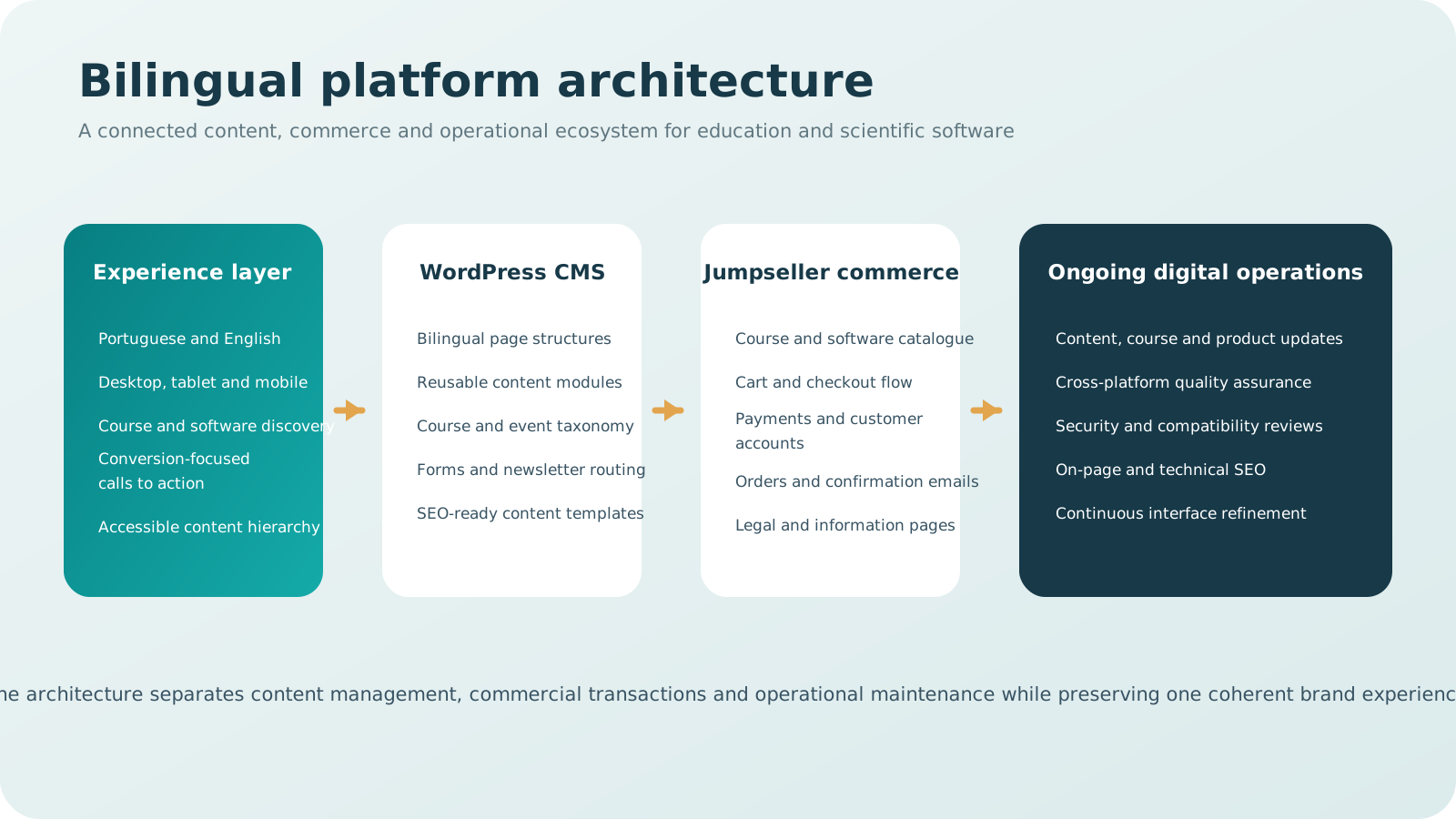
The solution combined a bilingual institutional platform developed in WordPress with a customised Jumpseller store. Together, both environments support discovery, evaluation, registration, software purchase, lead generation and ongoing content growth.
Experience scopeInstitutional content and commercial journeys
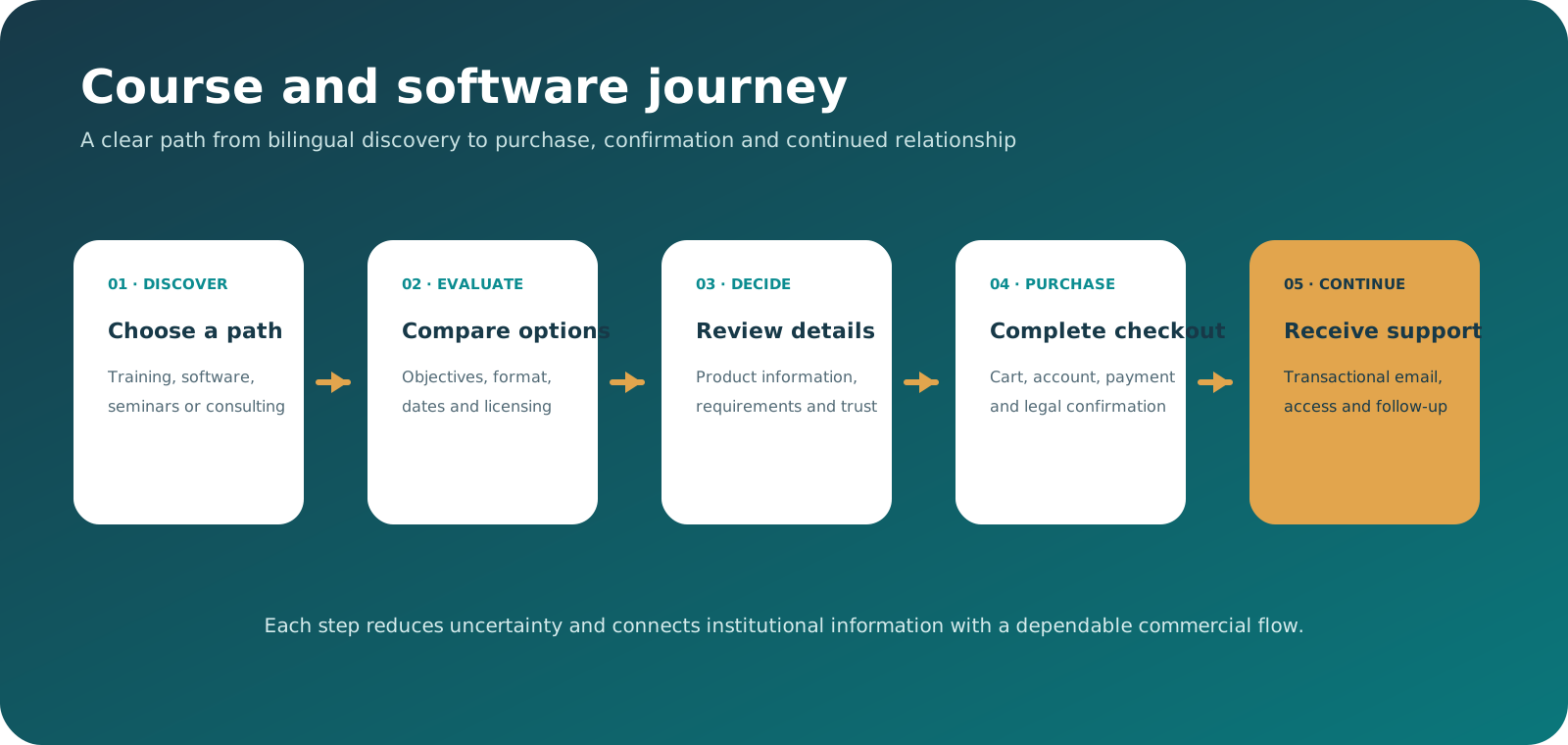
The platform connects detailed educational information with direct purchasing and contact paths.
Audience structureNational and international users
Portuguese and English content structures support professionals, researchers, companies and academic audiences.
Operational modelActively managed after launch
The engagement continues through content updates, quality assurance, SEO and store coordination.
02 · Platform challenge
Complex expertise had to become understandable, searchable and commercially actionable.
The main challenge was not simply to display a large catalogue. The interface needed to establish meaningful relationships between business areas, subject categories, individual courses, scientific-software products, seminars and consulting services.
Users arrive with different intentions. Some already know the software they need; others are comparing training programmes, searching by methodology or trying to understand which solution best fits a research project. The platform therefore required clear taxonomy, consistent page structures and calls to action appropriate to each stage of decision-making.
01
Catalogue complexity
Courses, software and consulting needed distinct structures while remaining part of one coherent ecosystem.
02
Bilingual consistency
Navigation, content relationships and commercial paths had to remain equivalent across Portuguese and English.
03
Cross-platform continuity
The WordPress website and Jumpseller store needed to feel like one brand rather than disconnected systems.
04
Long-term scalability
New courses, dates, products and specialist content had to be publishable without redesigning the platform.
03 · Role and workflow
The project connected UX strategy, interface design, implementation and ongoing platform governance.
The work covered the organisation of information architecture, user journeys, low-fidelity wireframes, responsive UI direction, WordPress content structures, Jumpseller storefront customisation, forms, checkout configuration, testing, SEO and post-launch maintenance.
Rather than treating design and implementation as separate phases, decisions were validated against real content, catalogue behaviour and operational requirements. Reusable patterns were prioritised so that the system could grow without introducing unnecessary variation.
04 · Information architecture
A structured taxonomy connects business areas, catalogue categories and conversion paths.
The navigation model separates the principal service areas while preserving contextual links between them. Training categories lead to individual programme pages; the software area organises products by research and analysis needs; seminars and consulting remain visible as complementary services.
At page level, content follows a predictable hierarchy: purpose, audience, learning or product value, technical details, format, commercial information and next action. This consistency reduces cognitive load and helps users compare options more efficiently.
Architecture principle
Complex catalogues become easier to navigate when the system distinguishes what a solution is, who it is for, what decision the user must make and which action should follow.
05 · Wireframes and responsive UI
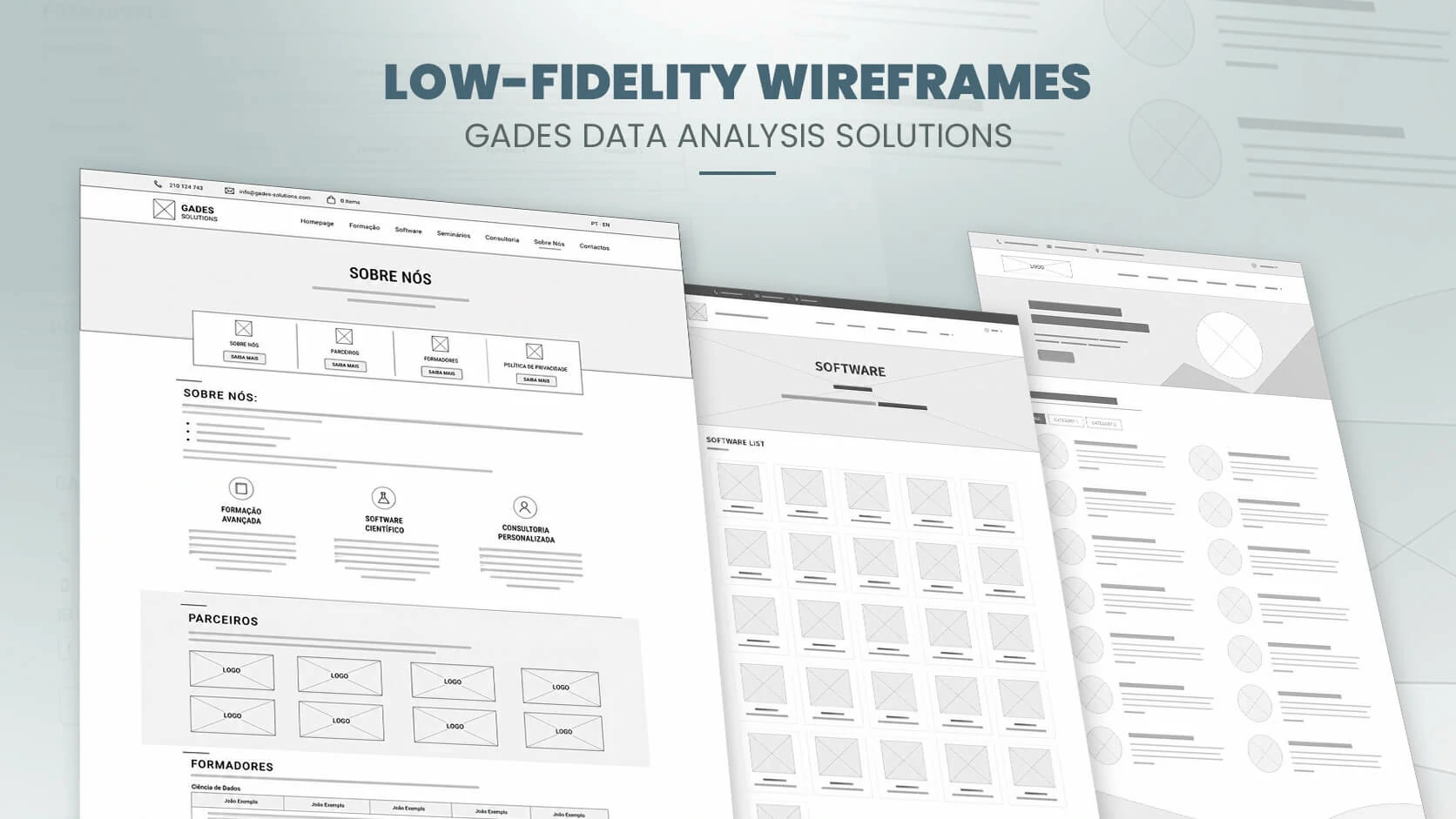
Low-fidelity wireframes established hierarchy, modularity and responsive behaviour before visual refinement.
The wireframing phase focused on page composition, navigation depth, catalogue density, content sequencing and reusable modules. This allowed structural decisions to be tested before typography, imagery and brand colour were applied.
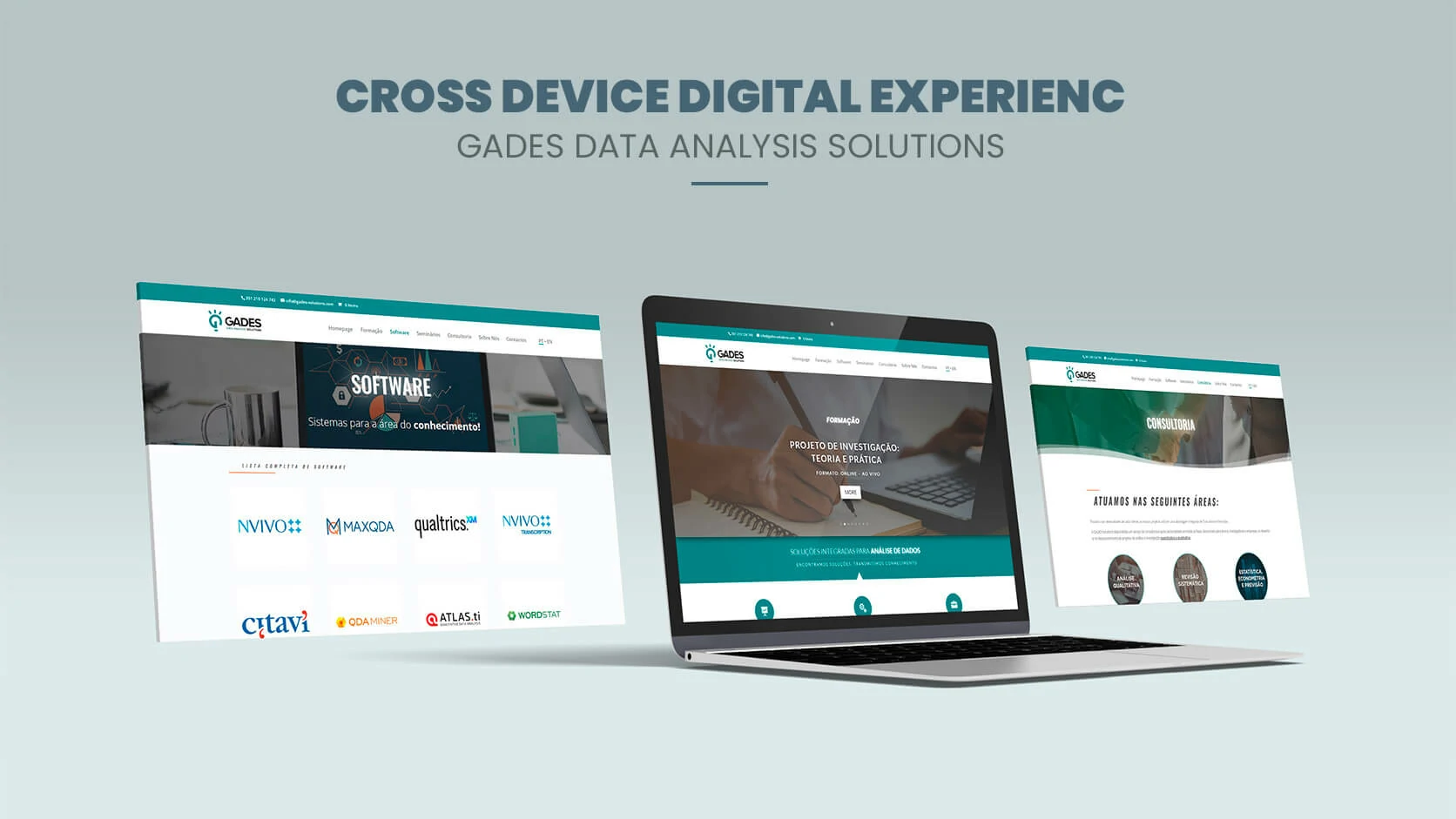
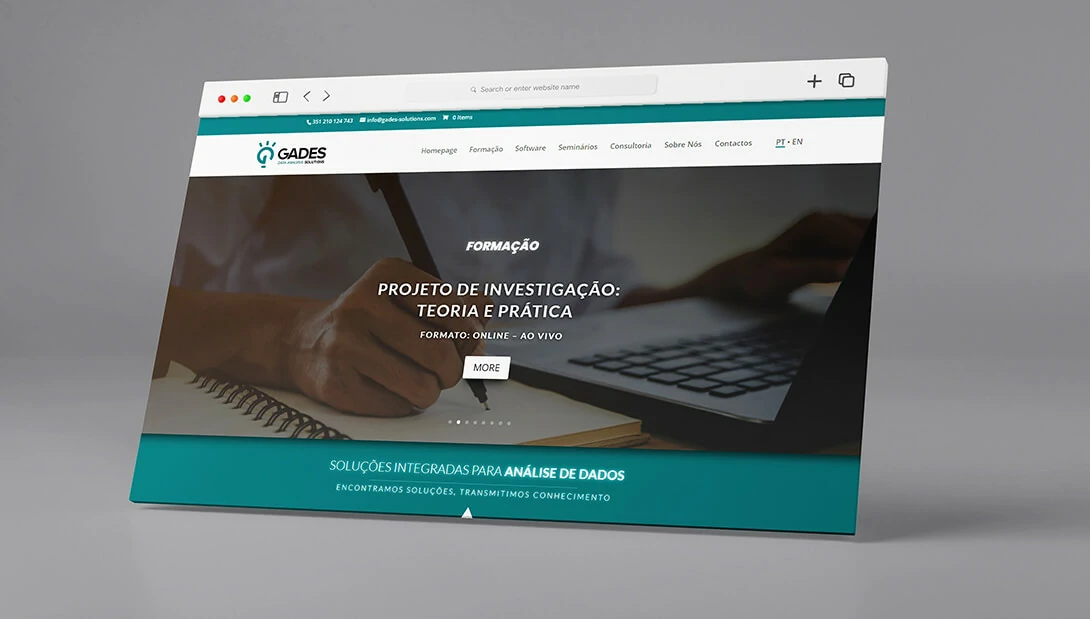
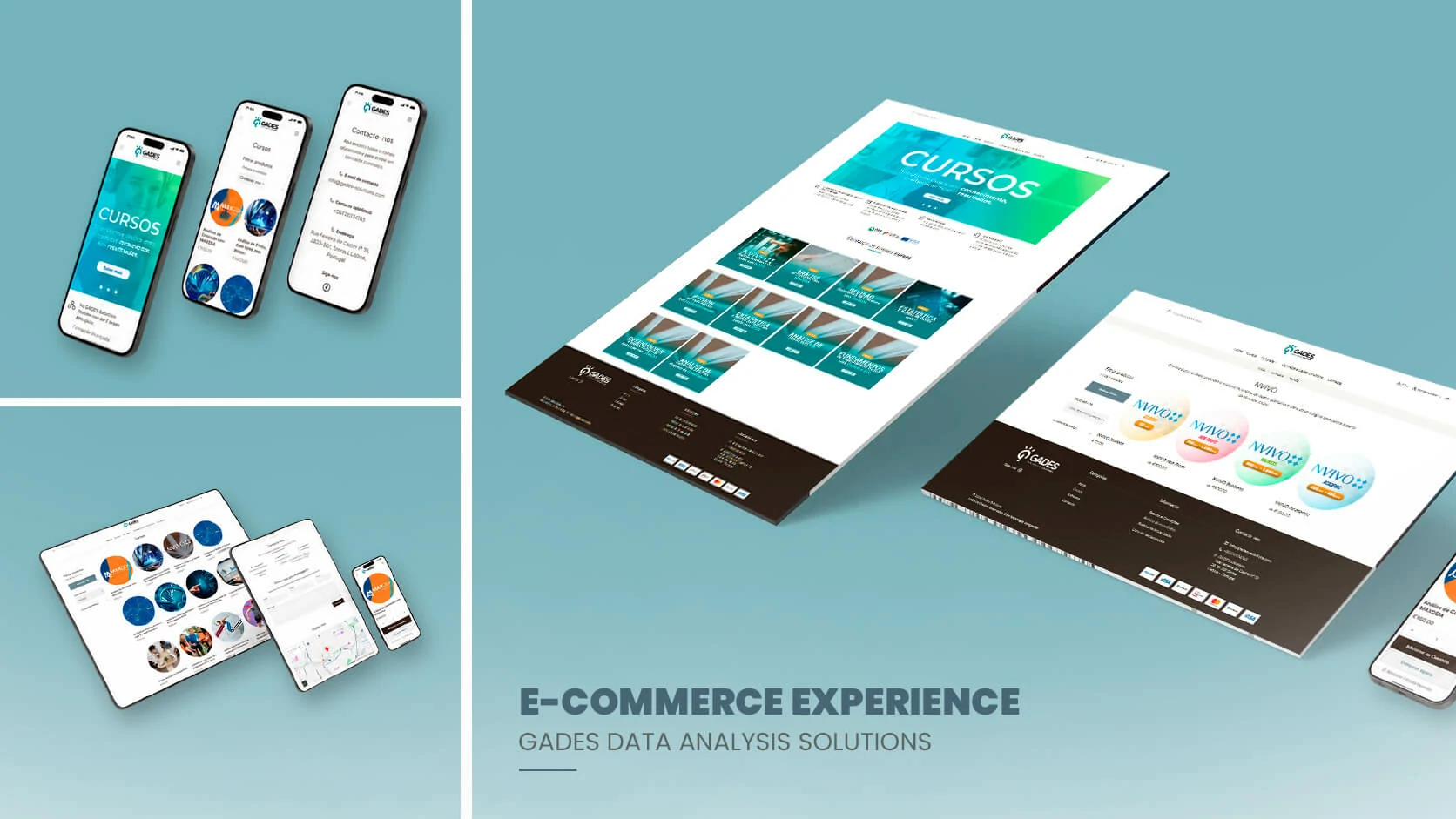
The final interface translates that structure into a clean responsive system across desktop, tablet and mobile. Shared headers, content blocks, cards, lists and calls to action create continuity while accommodating pages with very different levels of technical detail.
06 · E-commerce experience
Jumpseller provides proven commerce infrastructure within a customised Gades Solutions experience.
The online store supports both training programmes and scientific-software products. Its interface was customised to preserve visual continuity with the institutional platform while providing the transactional functionality required for direct online purchases.
The implementation covered storefront UI, catalogue architecture, product and course pages, cart and checkout configuration, payments, customer accounts, purchase confirmation, transactional emails, legal pages and end-to-end functional testing.
01
Catalogue modelling
Courses and software products use structured content appropriate to different commercial decisions.
02
Purchase continuity
Visual language, terminology and navigation reduce the perceived transition between website and store.
03
Transactional clarity
Cart, checkout, account and confirmation states provide clear feedback throughout the purchase process.
04
Quality assurance
The complete journey was tested across devices, browsers and representative product scenarios.
07 · Technical delivery
Two specialised platforms operate as one maintainable digital ecosystem.
WordPress supports the bilingual institutional structure, reusable page modules, forms, course content, seminars, consulting information and editorial updates. Jumpseller manages the commercial catalogue, customer accounts, payments, orders and transactional communication.
The implementation also included responsive front-end behaviour, content validation, form configuration, navigation and taxonomy reviews, cross-browser testing and integration between institutional and transactional paths.
08 · Ongoing maintenance and SEO
The platform continues to evolve alongside the company’s catalogue and commercial strategy.
Post-launch work includes course and product updates, new content implementation, interface adjustments, functional testing, compatibility reviews and coordination between the WordPress website and Jumpseller store.
On-page SEO is managed as part of the content workflow rather than as a separate final step. Page titles, meta descriptions, semantic heading structure, URLs, internal links, image alternative text, indexability and content formatting are reviewed as the platform changes.
Content operations
New courses, dates, software products and institutional updates are implemented within reusable structures.
Platform assurance
Functional, responsive, security and compatibility checks support dependable day-to-day operation.
Search visibility
Technical and editorial SEO improvements strengthen the discoverability of specialist offers over time.
09 · Full project gallery
From structural wireframes to a connected bilingual education and commerce experience.
The gallery documents the responsive platform, interface structure, e-commerce environment and technical logic that support the ongoing Gades Solutions ecosystem.
10 · Outcome and learning
An actively managed platform that supports education discovery, software sales and long-term business growth.
The resulting ecosystem gives Gades Solutions a coherent bilingual presence across institutional content and direct commerce. Users can understand the company’s expertise, compare relevant solutions and complete appropriate actions without navigating disconnected experiences.
Clearer service discovery
Structured navigation and reusable page hierarchies make a complex catalogue easier to understand.
Connected commercial flow
The institutional website and Jumpseller store work together as one recognisable customer experience.
Sustainable platform growth
Ongoing operations, reusable components and SEO allow the system to evolve with the business.
Design learning
For content-rich education platforms, interface quality depends as much on taxonomy, governance and operational continuity as it does on visual design. A system succeeds when new content can be added without weakening the user journey.